

4.7 stars based on 205,946 Trustpilot reviews
Should I Sell My Car or Repair It?
Weighing repairs vs. resale? Here's how to make the smartest move for your wallet and sanity.
4.7 stars based on 205,946 Trustpilot reviews
As seen on:


What to do when car repairs break the bank
You’re staring at a $3,000 repair estimate for your trusty Honda Civic with 180,000 miles. Your gut says, “This isn’t worth it,” but your wallet whispers, “A new car loan sounds worse.” Sound familiar?
Whether you are purchasing a new vehicle or want to buy a used car, deciding to repair or sell your car can be tough. It involves both financial and emotional ups and downs. In this guide, we’ll break down the key questions: When is a repair too expensive?
When does a car become not worth the money? When is it not worth repairing a car? Let’s look at why services like Peddle can be a stress-free solution. Let’s dive in.
The golden rule: repair cost vs. car value
The most common advice is to compare the repair costs to your car’s current value. If the bill exceeds 50% of its value, it’s often smarter to sell your car.
For example:
- A $3,000 transmission repair on a car worth $7,000? Fix your car, it buys you more time.
- A $5,000 engine replacement on a car valued at $6,000? Sell it, you’re throwing good money after bad.
But there’s nuance:
- Emotional attachment: If your car has special meaning to you, you might decide to repair it, even if it doesn’t make sense.
- Future reliability: A $2,000 repair that adds 2+ years of life is often cheaper than a newer car’s payment.
- Safety features: Older cars may lack modern tech like automatic braking or lane assist. If your car's safety features are old, buying a new car or a used one with modern systems could be worth the cost. This can help you feel safer on the road.
Decision-making checklist:
- Get a detailed repair estimate from a trusted mechanic.
- Research the car’s current value (like with our Car Value Estimator).
- Apply the 50% rule.
- Factor in emotional value, safety, and reliability.
- Compare repair costs to new car payments/insurance.
- Explore alternatives (trade-in, donation, etc.).
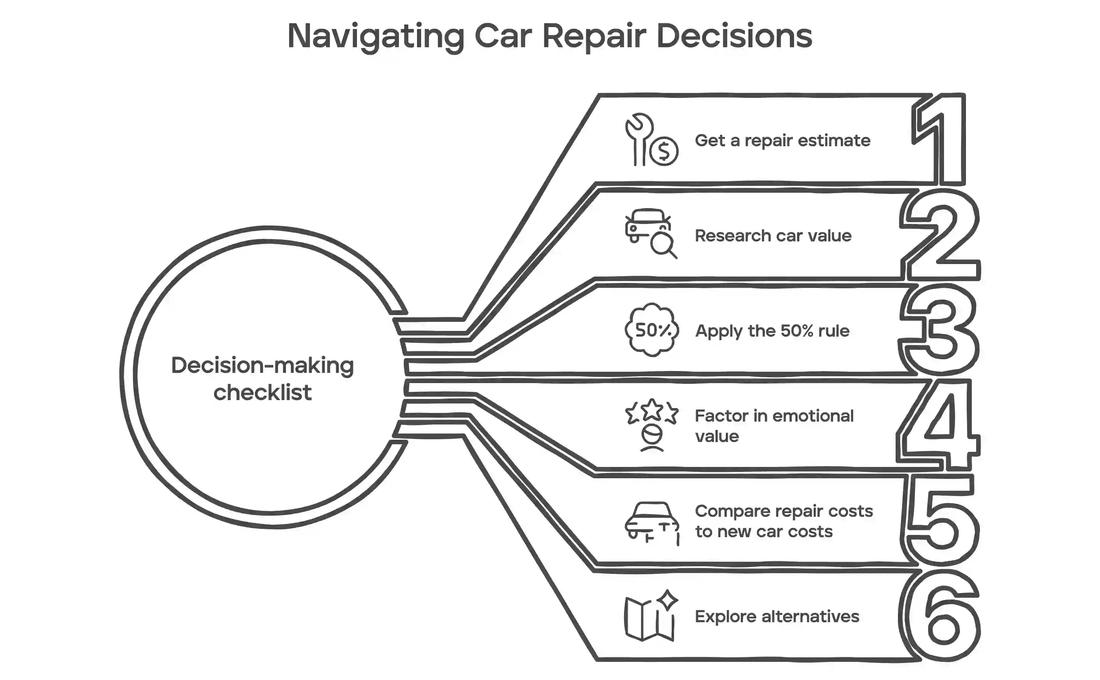
Use this 6-step checklist to confidently decide whether to repair or replace your car.
By looking at these factors together, you can make a choice that is smart with money and satisfying for you. Always seek a mechanic's advice for repair longevity, and opt for a pre-purchase inspection when buying used.
Pro Tip: Use our free Car Value tool to estimate your car’s worth.
The 200k-mile dilemma: should you fix or ditch?
Manufacturers build cars today to last. Modern vehicles can easily surpass 200,000 miles with proper maintenance, especially reliable brands like Honda or Toyota. However, mileage alone isn’t the full story.
Ask yourself:
- How’s the maintenance history? A well-documented service record boosts confidence in a high-mileage car’s longevity.
- What’s breaking? A timing belt replacement (600–1,000 miles) is routine, but a failing transmission (3,000–7,000 miles) might signal the end.
- Can you afford surprises? Even reliable cars develop issues after 200k miles. Budget $100/month for car repairs to avoid financial strain.
- Safety risks: Failing brakes or airbags? Focus on repairs if safety features are at risk. However, consider the cost of repairs compared to buying a newer model.
When to stop pouring money into your car
Here are the red flags that it’s time to let go:
- Repairs exceed the car’s value (the 50% rule).
- Breakdowns are frequent (e.g., monthly trips to the shop).
- Safety risks: Critical safety features like brakes or airbags are failing.
- You're emotionally exhausted. Constant stress is not worth it.
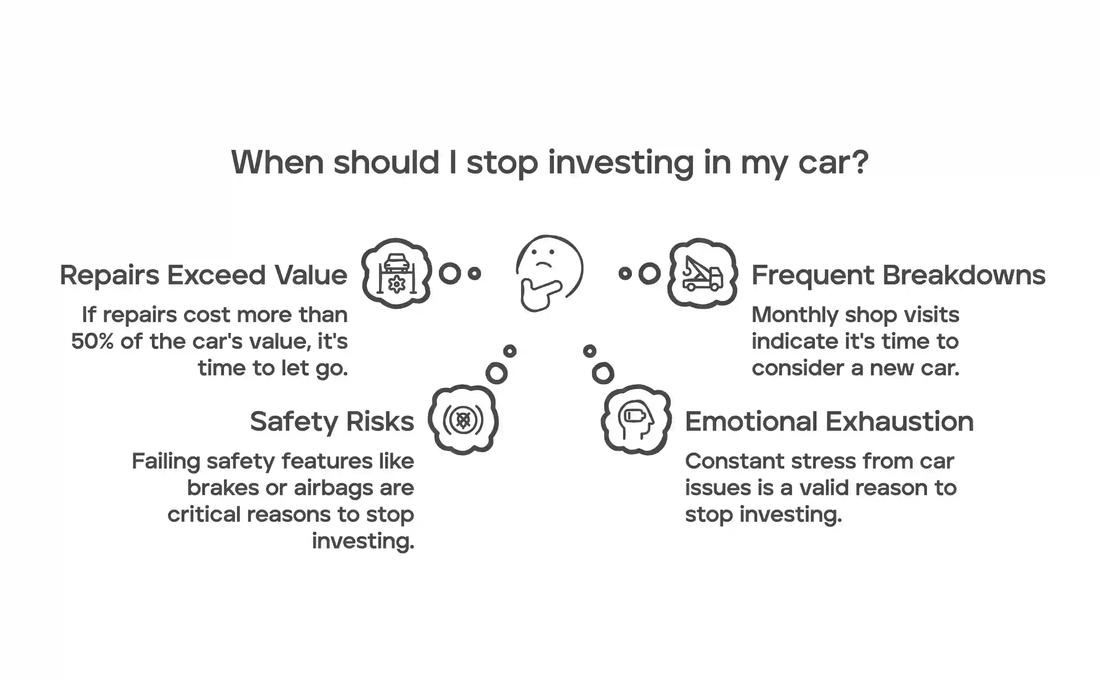
Know the signs it’s time to stop sinking money into your car.
Example: If your car needs a $2,800 repair but is only worth $3,500, you can sell it “as-is.” Using a service like Peddle can help you make a profit without the hassle of private sales.
Repair vs. sell: key comparisons
Let’s break down the financial and practical implications:
Weighing the Costs: Car Repair vs. Selling
Factor | Repair | Sell |
|---|---|---|
Upfront Cost | $500 - $3,500+ (depending on your issue) | $45-$75. If you need to tow (Peddle offers free towing) |
Long-Term Costs | Lower (no loan payments) | None! |
Time/Effort | Lengthy, depending on the type of repair | It can be lengthy when selling privately, or faster with a service like Peddle. |
Reliability | Uncertain (depends on repair quality) | More reliable through trusted services like Peddle. |
Stress Level | Moderate (risk of future repairs) | Low (peace of mind with a newer vehicle) |
Why Peddle is the smart choice for selling
If you think your car isn't worth repairing and want to sell it, Peddle makes it easy. This is especially true for high-mileage or damaged cars.
Here’s why it stands out:
- Instant offers: Get a quote in minutes.
- Free pickup: No need to leave your driveway.
- No haggling: Avoid private buyer stress.
- Flexible terms: They buy cars in any condition.
Comparison:
- Private sale: Higher payout, but requires advertising and scam vigilance.
- Dealership trade-in: Fast, but it undervalues your car.
- Peddle: Middle-ground payout with zero effort, ideal for urgency.
Real-life scenarios: what would you do?
Scenario 1: A 2010 Toyota Camry with 220k miles needs a $1,200 alternator repair.
- Value: ~$3,000.
- Choice: Repair. The cost of repairs is 40% of its value, and Toyotas often last 250k+ miles.
Scenario 2: A 2012 Ford Focus with 150k miles needs a $4,000 transmission replacement.
- Value: ~$4,500.
- Choice: Sell. The repair costs 89% of its value, and Focus models are prone to transmission issues.
The emotional side: letting go of your car
Cars often feel like family members. But emotions can cloud judgment.
Ask:
- Is safety compromised?
- Can I afford repairs and a future down payment?
- Would selling free up cash for other goals?
Pro Tip: If your state's registration fee goes up as your car gets older, selling it before renewal may save you money. Don’t forget hidden costs like registration fees or looming repairs can add up fast.
If repairing a car feels like using a band-aid, selling might be the stitch you need. Remember, the right choice isn’t just about today’s repair bill; it’s about tomorrow’s peace of mind.
Conclusion: your roadmap to a decision
- Calculate the numbers: Compare repair costs to your car’s value.
- Assess reliability: Check maintenance records and safety features.
- Consider alternatives: Could selling fund a safer, newer car or a used car with better tech?
- Trust your gut: Balance logic with peace of mind.
Whether you decide to repair or sell, the goal is to align with your budget and lifestyle. A car is a tool, not a trophy. Letting go of a money pit could be the first step toward financial freedom.
Final Thoughts for the Car Owner
Every car owner faces this crossroads. While fixing your car might seem loyal, buying a new car (or a used car) could offer long-term savings and safety.
Need to Sell Fast? Get an instant offer from Peddle today—no paperwork, no hassle, and free pickup in 48 hours.